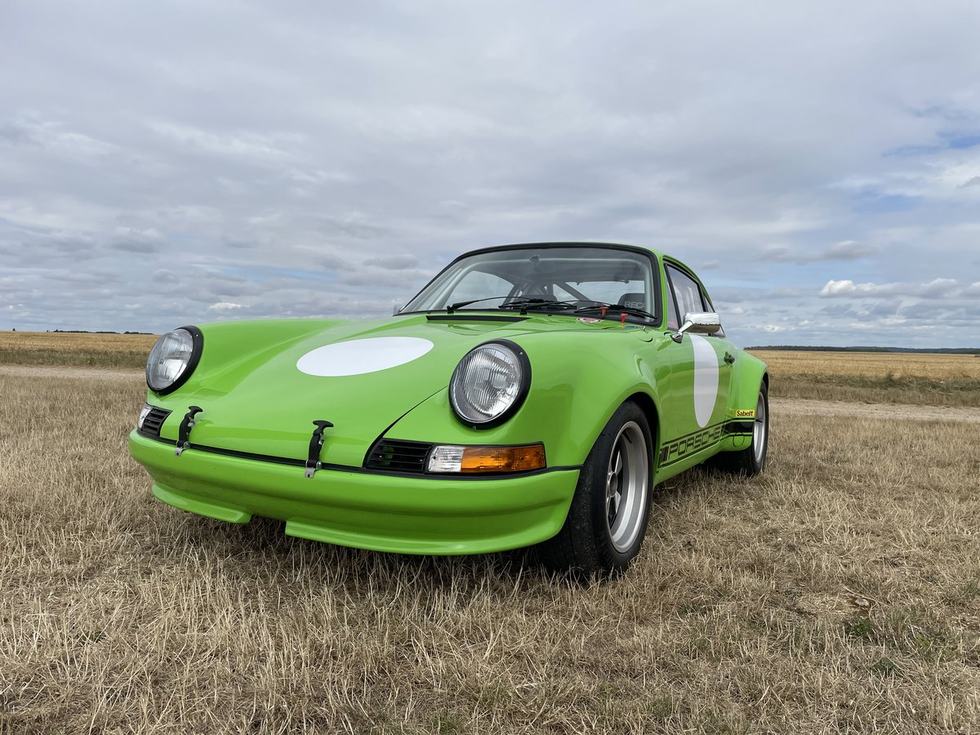
Unveiled in 1963 to succeed the 356, the Porsche 911 stayed true for more than thirty years to a single principle: an air-cooled flat-six engine mounted at the rear. Here is the history of the air-cooled 911, from the 901 to the 993.
From 901 to 911, 1963-1964
The Porsche 911 was unveiled at the 1963 Frankfurt Motor Show as the 901, an internal project number. Peugeot objected to three-digit names with a zero in the middle, so the car was sold as the 911. Production began in September 1964, and the styling was led by Ferdinand “Butzi” Porsche.
- Unveiled
- Frankfurt Motor Show, 1963
- Production start
- September 1964
- Engine
- Air-cooled flat-six, 1,991 cc
- Power
- 130 PS (128 hp)
- Layout
- Rear-mounted engine
It took over from the Porsche 356, which went out of production in 1965.
The key stages, 1966 to 1998
Over thirty years, the 911 grew and diversified without changing its architecture. Here are the landmarks to know.
- 1966The 911 S arrives with 160 PS from the same 2.0 L displacement.
- 1967The Targa, with its removable roof, appears in August 1967.
- 1969The C series raises displacement to 2.2 L.
- 1973The Carrera 2.7 RS gets a 2,687 cc engine producing 210 PS.
- 1974The G series adopts new impact bumpers.
- 1975The 930 Turbo, the first production turbocharged 911, delivers 260 PS from 3.0 L.
- 1978The SC arrives with a 3.0 L engine.
- 1984The Carrera 3.2 gets a 3,164 cc engine.
- 1989The 964 moves to 3.6 L and 250 PS.
- 1998The 993, the last air-cooled 911, gives way to the water-cooled 996.
Displacement grows from 2.0 L in 1964 to 3.6 L in 1989. The SC series was built in 58,914 examples and the Carrera 3.2 in 76,473. About 150,000 air-cooled 911s (1964-1989) were estimated to be still on the road in 2014.
Why air cooling defined the 911
An air-cooled 911 has no radiator and no coolant: a fan blows air over the cylinders, and engine oil helps with cooling. This layout gave the 911 its mechanical character and its sound, until the water-cooled 996 arrived in 1998.
Dating a 911 at a glance
One simple landmark: before 1974, 911s have slim bumpers. From the G series in 1974, the impact bumpers set them apart at a glance. Displacement is often read in the name: 2.0, 2.2, 2.4, 2.7, 3.0, 3.2, then 3.6.
And today?
Many air-cooled 911s are still on the road. Their engine and gearbox need regular care, and some parts are getting hard to find. That is what we do at the workshop, for air-cooled Porsche 356 and 911: engine and gearbox overhaul and parts search. You can also see our work.
Frequently asked questions
What is the last air-cooled 911?
The 993, built until 1998. The 996 then moved to water cooling.
Why did the 901 become the 911?
Peugeot objected to three-digit names with a zero in the middle. The car unveiled in 1963 as the 901 was therefore sold as the 911.
When did 911 production begin?
In September 1964, after its unveiling at the 1963 Frankfurt Motor Show.
What is the difference between a pre-1974 and a post-1974 911?
From 1974, the G series adopts new impact bumpers, visible at a glance.
Do you work on air-cooled 911s?
Yes, we work on air-cooled Porsche 356 and 911. Tell us about your project from the contact page.
A project for your air-cooled 911? Let’s talk.
The De la Haye workshop team
Specialists in air-cooled Porsche 356 and 911, near Houdan.