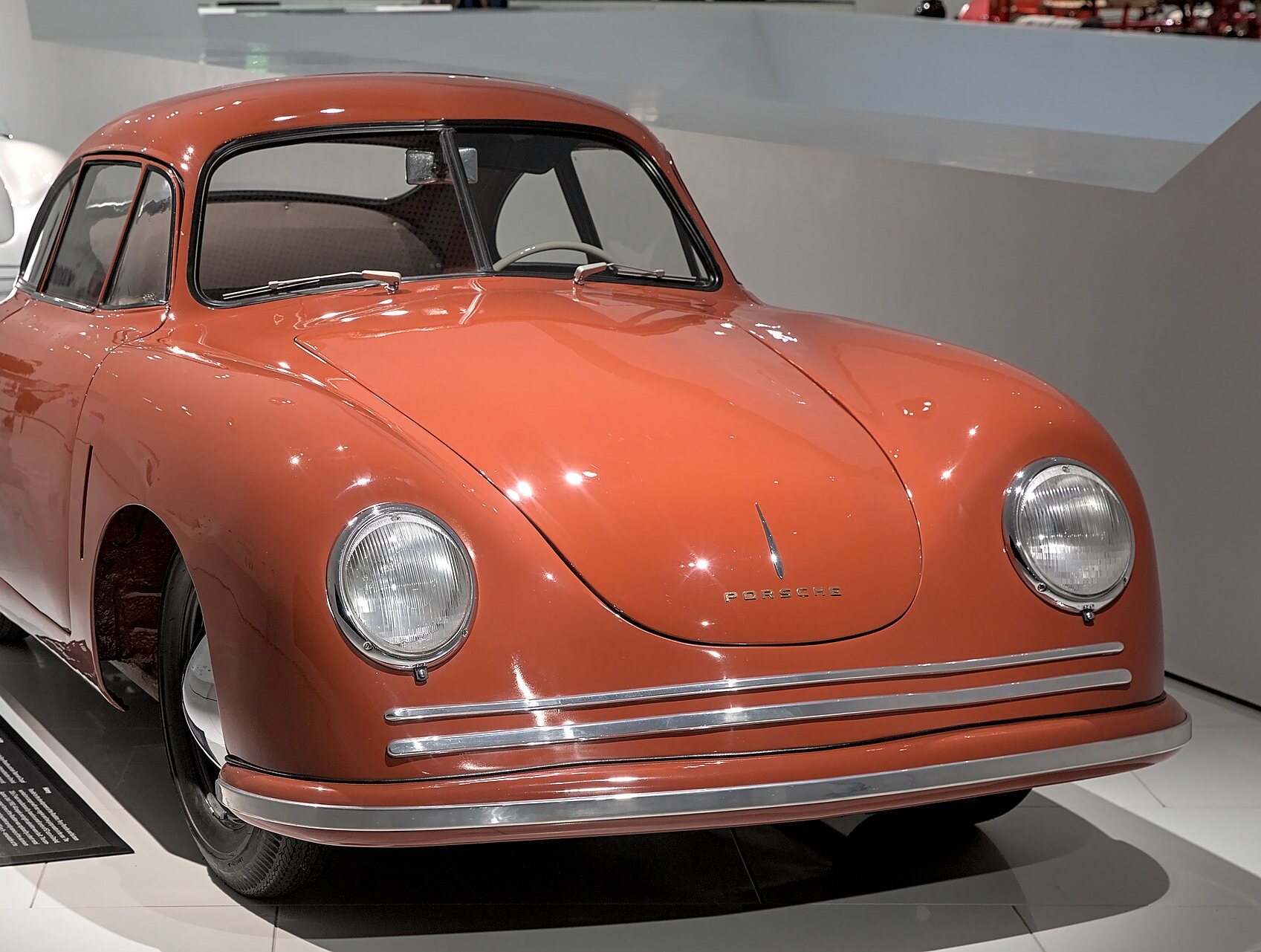
Photo: Alexander Migl, Wikimedia Commons, CC BY-SA 4.0 (cropped image)
Before the 911, there was the 356. Here is how the first Porsche was born in Austria in 1948, and how it became a production car.
Gmünd, 1948: the 356 “No. 1”
On 8 June 1948, the 356 “No. 1” Roadster received its operating permit in Gmünd, Austria. That date is generally considered the birth of the Porsche brand. The car came from an idea by Ferry Porsche: a light sports car built around a mid-mounted engine, placed ahead of the rear axle.
- Engine
- Volkswagen-based flat-four, 1,131 cc
- Power
- 35 hp (26 kW)
- Top speed
- 135 km/h (84 mph)
- Structure
- Steel tube frame, aluminium body
- Layout
- Mid-engine
About 50 cars were built in Gmünd before production moved.
Zuffenhausen, 1950: series production
In 1950, production moved to Zuffenhausen, Germany. The production 356 puts the engine at the rear. It stays linked to Volkswagen through its air-cooled flat-four, which uses the Beetle’s engine case, and through some suspension parts. The coupé came first, with a cabriolet from the start.
Built from 1948 to April 1965, the 356 was made in about 76,000 examples, roughly half of which are thought to survive.
Speedster, Carrera, A, B and C series
- 1954The Speedster arrives in late 1954. 4,854 were built, and the cabriolet D replaced it in late 1958.
- 1955The Carrera four-cam engine appeared for racing in late 1954, then as a road option on the 356 A in late 1955.
- 1959Series A ran from late 1955 to about 1959. Series B began in late 1959, and the T6 body arrived in 1962.
- 1964Series C brought disc brakes on all four wheels. Production peaked that year at 14,151 cars.
A car that still runs
The 356 stayed in production until April 1965, alongside the first 911, introduced in 1964. Many of these cars are still on the road today. They, along with air-cooled 911s, are what we work on at the workshop.
Want to know more about what we do? Discover our services · our work.
The De la Haye workshop team
Specialists in air-cooled Porsche 356 and 911, near Houdan.